

Overview of Robotic Surgery
Robotic surgery is an advanced form of minimally invasive surgery that allows surgeons to perform complex procedures with enhanced precision, control, and flexibility. Despite its name, the robotic system does not operate on its own. Every movement is guided entirely by the surgeon through a sophisticated computer-assisted console, ensuring complete control throughout the procedure.
The robotic system features high-definition 3D visualization and specialized instruments that can move with greater dexterity than the human hand. This enables surgeons to operate with exceptional accuracy, especially in delicate or hard-to-reach areas of the body.
Robotic surgery is widely used for procedures such as hernia repair, colorectal surgery, bariatric surgery, HPB surgery, urological, and gynecological operations. Compared with traditional open surgery, it typically requires smaller incisions, resulting in less pain, reduced blood loss, minimal scarring, a lower risk of infection, and faster recovery.
With its combination of cutting-edge technology and expert surgical care, robotic surgery offers many patients a safer, more comfortable path to recovery.
Advantages of Robotic Surgeries over Conventional Surgeries:
- Minimally invasive
- Greater precision
- Reduced blood loss
- 3D surgery powered by Artificial Intelligence
- Faster recovery
- Short hospital stay
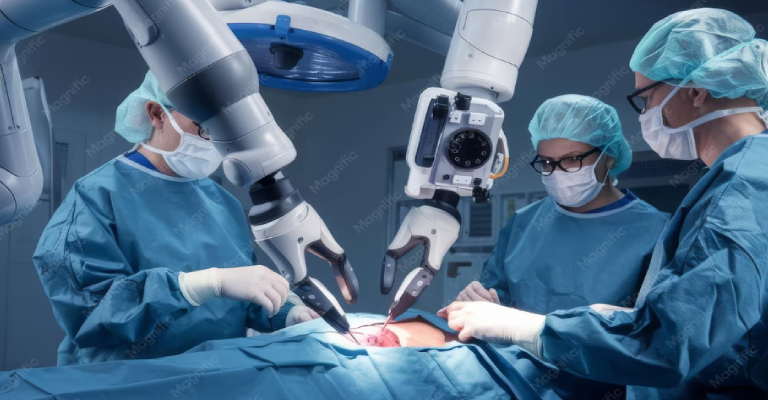
Robotic surgical systems are used in various surgeries such as:
Robotic General Surgeries
Robotic General Surgery is an advanced minimally invasive surgical technique that enables surgeons to perform complex procedures with greater precision, control, and flexibility. Using a high-definition 3D camera and robotic-assisted instruments, surgeons can operate through small incisions while preserving surrounding healthy tissues.
This technology is commonly used for procedures such as gallbladder surgery, hernia repair, colorectal surgery, stomach surgery, and selected liver and pancreatic operations. Compared with traditional open surgery, robotic-assisted procedures often result in less pain, reduced blood loss, minimal scarring, a lower risk of infection, shorter hospital stays, and faster recovery.
The robotic system does not perform surgery independently. Every movement is fully controlled by the surgeon, ensuring maximum precision and safety throughout the procedure. After a comprehensive medical evaluation, your surgeon will determine whether robotic surgery is the most appropriate treatment option. When suitable, robotic general surgery provides a safe, effective, and patient-centered approach that supports better surgical outcomes and a quicker return to everyday life.
Robotic in Weight loss surgeries
Robotic-assisted weight loss surgery is an advanced minimally invasive procedure that helps treat obesity with greater precision and control. Using a robotic system, surgeons perform bariatric procedures such as sleeve gastrectomy and gastric bypass through small incisions. The technology offers high-definition 3D visualization and enhanced instrument movement, supporting accurate surgical outcomes. Compared with traditional surgery, patients may experience less pain, reduced blood loss, minimal scarring, shorter hospital stays, and faster recovery. The robotic system is fully controlled by the surgeon, ensuring safety throughout the procedure. A thorough evaluation determines whether robotic bariatric surgery is the most suitable treatment option for each patient.